Growth is supposed to feel good. More orders. Bigger retailers. Stronger brand recognition.
But for many CPG brands, growth comes with an uncomfortable reality: cash feels tighter, not easier.
If you’ve ever looked at rising sales while worrying about payroll, production runs, or supplier payments, you’re not alone. Cash flow challenges are often not a sign of failure; they’re a sign that your business is scaling into a more complex financial reality.
In 2026, understanding how receivables, payables, and timing interact will be one of the most important skills for growing CPG brands.
Why Cash Flow Feels Harder as CPG Brands Grow
CPG businesses face a unique cash flow equation. Inventory is typically paid for upfront. Ingredients, packaging, co-packers, freight, and storage costs all hit before a product ever reaches a shelf.
On the other side, retailers and distributors often pay in 60–90 days or longer. Add in chargebacks, deductions, and compliance requirements, and the gap between when cash goes out and when it comes back widens quickly.
This disconnect is frustrating, but it’s not unusual. In fact, it’s a natural byproduct of growth. As order sizes increase, the cash required to support them grows faster than revenue itself.
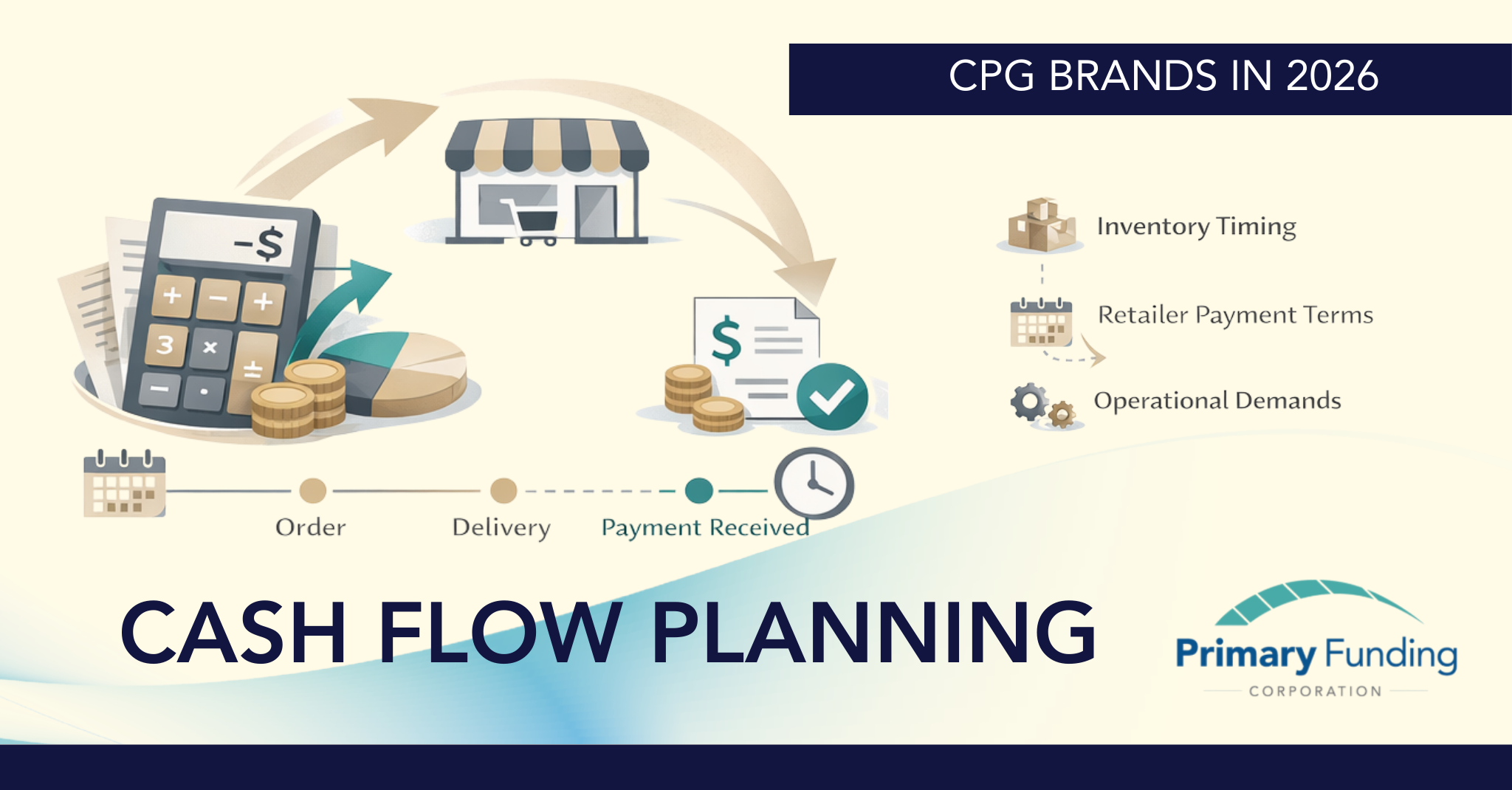
How Cash Actually Moves in a Growing CPG Business
To plan effectively, it helps to break the cash cycle down in simple terms.
Receivables are the payments you’re waiting on from retailers and distributors. These timelines are often fixed and non-negotiable, especially as brands scale into larger accounts.
Payables include everything required to produce and deliver your product: raw materials, manufacturing, packaging, logistics, and overhead. These costs usually need to be paid well before revenue arrives.
Inventory lag is the space in between when cash is tied up in product that hasn’t yet been sold or paid for.
The key insight here is that timing matters more than top-line sales. A profitable business on paper can still struggle if cash inflows and outflows aren’t aligned.
The Growth Trap: When Sales Increase but Cash Tightens
One of the most common misconceptions among scaling CPG brands is, “We’re profitable, so cash shouldn’t be an issue.”
Profit and cash flow are not the same thing.
As sales grow, so do the demands on working capital. Larger orders require more inventory. Expanding SKUs increases production complexity. New retail relationships often come with longer payment terms.
The result? Cash gaps widen just as the business appears to be thriving. Without planning, growth itself can become a strain.
One way to think about how cash moves through a business is through the Cash Conversion Cycle (CCC) — the time it takes to turn inventory and receivables into actual cash on hand. Learn more about CCC and how it reflects timing in cash flow, here.
What CPG Brands Should Be Planning for in 2026
Looking ahead to 2026, several realities are shaping cash flow planning for CPG brands:
- Retailers continue to push longer payment terms and stricter compliance.
- Inventory expectations are rising, with less tolerance for stockouts.
- Traditional banks remain cautious, especially with inventory-heavy businesses.
In this environment, cash flow planning should be a growth strategy emergency tool. Brands that understand their cash cycles early are better positioned to scale confidently, not reactively.
Real Talk Solutions: Planning Without Overcomplicating It
Cash flow planning doesn’t require complex spreadsheets or perfect forecasts. It starts with clarity.
- Forecast cash based on timing, not just revenue projections.
- Stress-test scenarios like larger purchase orders or slower-paying accounts.
- Understand how much working capital is required to support growth, not just survive it.
When done thoughtfully, outside capital can support momentum rather than plug holes. The key is using funding intentionally, as part of a plan.
Where a Relationship-Driven Funding Partner Fits
The right funding partner should provide capital and help bridge the gap between receivables and payables with transparency and consistency.
For growing CPG brands, funding works best when it supports planning, not panic. When conversations focus on timing, goals, and long-term sustainability, capital becomes a tool, not a crutch. We partner with multiple CPG organizations, read more here.
Cash Flow Clarity Is a Growth Advantage
Growth is good, but only when cash can keep up.
For CPG brands planning for 2026, understanding how receivables, payables, and inventory timing work together is one of the strongest competitive advantages you can build.
If growth is on your roadmap, clarity around cash flow is the first step